
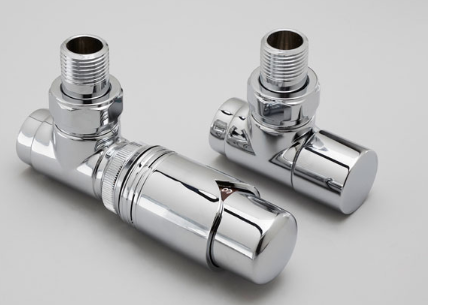
One of the most common questions we hear is:
“Do I need valves on my radiators or towel warmers?”
The short answer is: not necessarily.
Whether you need valves depends less on the radiator itself and more on how your hydronic heating system is designed and controlled.
Many homeowners, designers, and even contractors assume valves are automatically required because they often see European-style radiator installations with valves connected to nearly every radiator. Since our products follow that same European design aesthetic, it’s easy to assume valves are part of every installation.
But the real question is not simply, “Do I need valves?” The better question is, “Is my heating system designed to use them?”
That distinction matters.
Traditional North American hydronic systems are typically controlled by wall thermostats that turn circulators or boilers on and off based on temperature demand. Many European systems operate differently. Instead of controlling large heating zones, they often use thermostatic radiator valves (TRVs) mounted directly on each radiator, allowing individual room temperature control.
A thermostatic radiator valve regulates the flow of hot water through the radiator based on room temperature. It’s important to understand that a TRV is a mechanical device not an electrical control.
A TRV does not:
- turn the boiler on or off,
- activate a circulator,
- or send electrical signals through the system.
It simply opens or restricts water flow through the radiator depending on the room temperature setting. Because of this, water must already be circulating through the system for the valve to function properly. That’s why TRVs should only be used in systems designed for that type of operation.
Thermostatic valves work especially well in:
- constant circulation systems,
- applications requiring room-by-room comfort control,
- and certain towel warmer installations.
We do offer thermostatic radiator valves, particularly for towel warmers, but proper application is important.
It’s also important to distinguish between thermostatic valves and standard shutoff valves. Shutoff valves are commonly used to isolate a radiator for maintenance, remove a unit from the wall, or create a cleaner finished appearance at the piping connection.
On towel warmers especially, decorative shutoff valves are often chosen for aesthetic reasons. They help create a more refined installation by concealing or enhancing exposed piping connections.
In many hydronic systems, valves are optional. The key is understanding how the heating system is designed and whether it is intended to operate with thermostatic radiator valves.
At the end of the day, the question is not, “Do I need valves?” The real question is, “Is my system designed to use them?”